
Reviewed · FATEHPUR SIKRI TOURS
Affordable transfer from Agra to Jaipur via Fatehpur Sikri
Fatehpur Sikri is the real reason to consider this Agra to Jaipur transfer. Instead of giving up a sightseeing day to move between cities, you spend about four hours among red sandstone palaces, courtyards, mosques, and the huge Buland Darwaza. It turns a long road journey into a useful half-day visit.
I like the private vehicle, which means your group travels with its luggage and does not have to follow a large coach schedule. I also like the clear city-to-city plan: pickup in Agra, a substantial stop at Fatehpur Sikri, and drop-off anywhere within Jaipur.
The main caution is that this is a transfer with sightseeing, not a fully guided historical tour. Entry tickets and a guide are not included, and you should confirm that tolls and fuel are covered before setting off, since one booking resulted in an extra charge for those items.
In This Review
- Key points to know before booking
- Why Fatehpur Sikri makes the road day worthwhile
- Entering through Fatehpur Sikri Dargah and Buland Darwaza
- Diwan-I-Khas and the emperor’s public spaces
- Panch Mahal and the palace quarters
- Khwabgah and Pachisi Court
- What the private transfer is really like
- Price, guide costs, and the real value
- Who should book this Agra to Jaipur route
- Should you book it?
- FAQ
- How long does the transfer take?
- Where does the journey begin?
- Where does the journey end?
- How long do you spend at Fatehpur Sikri?
- Is this a private tour?
- Is transportation included?
- Are bottled drinks provided?
- Are a guide and entry tickets included?
- Can you cancel for a refund?
Key points to know before booking
- Four hours at Fatehpur Sikri: Enough time for the major buildings, though a guide would help explain the site.
- Private transport with luggage: Your group has the vehicle to itself, with pickup in Agra and drop-off anywhere in Jaipur.
- No guide or entry tickets included: Plan for separate admission costs and arrange a guide if you want detailed context.
- Air-conditioning and bottled water: Useful comforts during an 8 to 9-hour road day.
- Shopping-stop caution: One booking included stops at shops, so make it clear if you prefer to spend your time at the monument.
- Free cancellation up to 24 hours: A useful safety net if your India itinerary changes.
Why Fatehpur Sikri makes the road day worthwhile
The usual problem with moving from Agra to Jaipur is that you lose most of a day to the road. This trip solves part of that problem by placing Fatehpur Sikri between the two cities. You still spend much of the day in a car, but the stop gives the journey a strong cultural focus.
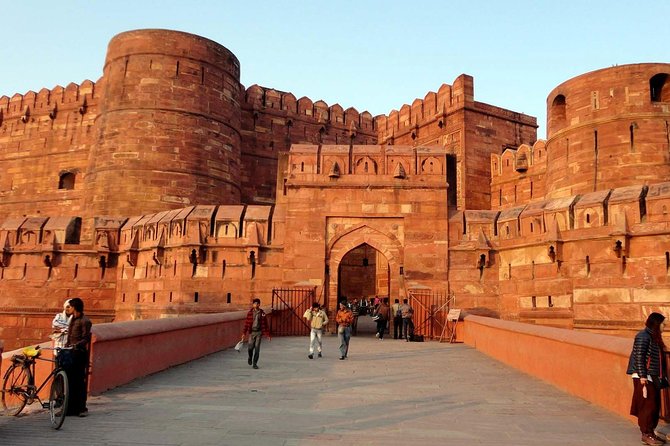
Fatehpur Sikri was founded in the 16th century by a Mughal emperor and built largely in red sandstone. Its compact core brings together imperial halls, private apartments, religious buildings, and open courts. You can see a lot without walking between widely scattered monuments.
The four-hour stop is the heart of the experience. That is enough time to see the key buildings at a measured pace, take in the courtyards, and pause for photographs. It is not unlimited time, so you will want to keep the visit moving, especially if the road portion takes longer than expected.
Your vehicle is private, but the sightseeing is not described as a private guided tour of each monument. You will need to decide if you are happy reading signs and exploring independently, or if you want to hire a local guide separately. The available information specifically notes that the experience comes without a guide or entry. That keeps the base price low, but it also places more planning on you.
More Private Drivers in Agra
- Private Transfer Agra to Jaipur with Fatehpur Sikri
★ 5.0 · 135 reviews - Private Transfer From Agra To Jaipur with Fatehpur Sikri
★ 5.0 · 117 reviews - Private Transfer From Agra to New Delhi
★ 5.0 · 104 reviews
Entering through Fatehpur Sikri Dargah and Buland Darwaza
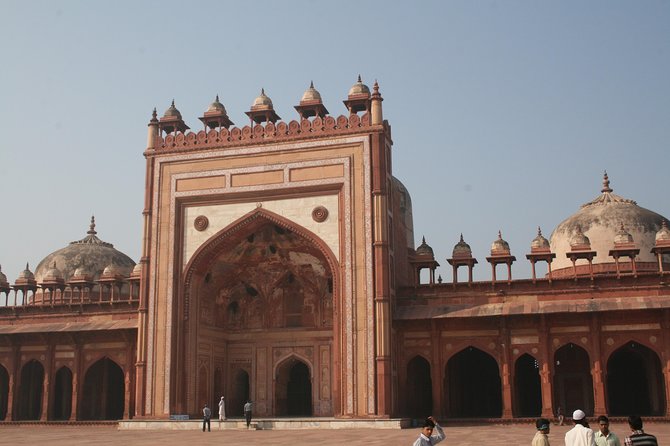
The visit begins around Fatehpur Sikri Dargah, a religious area connected with the city’s Mughal foundation. The site then opens toward Jama Masjid and the monumental Buland Darwaza, the gate that gives the complex much of its visual drama.
Buland Darwaza is not a minor entrance you pass through without thought. Its scale changes your sense of the whole city. From below, the great red sandstone gateway rises above the surrounding buildings and steps, creating one of Fatehpur Sikri’s most memorable views.
Jama Masjid is another essential stop. The mosque gives the complex a working religious character rather than making it feel like only a palace museum. You will want to dress and behave with respect in this part of the site, and you should allow time to notice the contrast between the red sandstone surroundings and the pale marble Tomb of Salim Chisti nearby.
The tomb is dedicated to Salim Chisti, the Sufi saint associated with the founding story of Fatehpur Sikri. Its marble surface and fine detail provide a sharp contrast to the heavier sandstone buildings around it. This is one place where a guide can add real value, since the religious meaning is less obvious than the architecture.
Diwan-I-Khas and the emperor’s public spaces
The Diwan-I-Khas, or Hall of Private Audience, is known for its carved central pillar. That pillar is the detail to look for, rather than simply walking into the room, taking a photograph, and leaving. Its design reflects the courtly purpose of the building and shows the care given to spaces used for imperial meetings.
You also visit the Diwan-I-Aam, the Hall of Public Audience. The contrast between the two halls helps you understand how the court functioned. One was associated with more private meetings, while the other served a broader public role.
Ibadat Khana, the House of Worship, adds another layer to the complex. The name alone can make it easy to confuse with the main mosque, but it has its own place in the imperial setting. Together, these buildings show that Fatehpur Sikri was planned as a complete court city, not merely a palace with a decorative gateway.
If you are exploring without a guide, keep the names of the buildings in your phone and check them as you go. The site includes many courtyards and structures that can blur together after several hours. A simple route plan will help you remember what you have seen.
Panch Mahal and the palace quarters
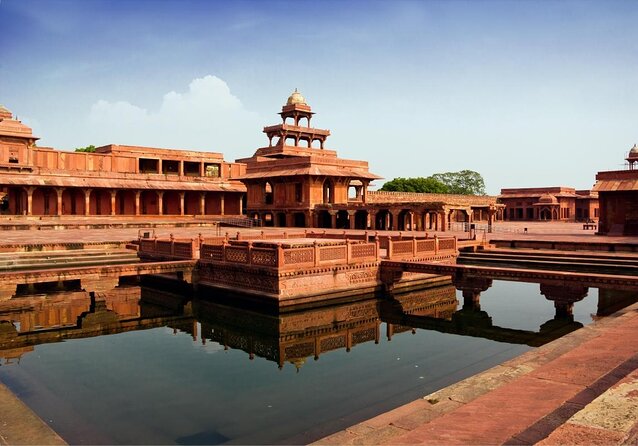
Panch Mahal is one of the most distinctive buildings at Fatehpur Sikri. Its five levels rise in an open, columned form, and the upper portions offer broad views over the site. It is a good place to slow down and consider how the complex was arranged around courts and open space.
Jodha Bais Palace, also called Mariam-uz-Zamani’s Palace in the itinerary, shows a mix of Hindu and Mughal architectural styles. The combination is one of the most interesting details at Fatehpur Sikri. Look for changes in column forms, decorative treatment, and the way the rooms relate to the surrounding courtyard.
The palace buildings are valuable because they make the city feel lived in. Large gates and halls show imperial power, but domestic spaces help you picture daily court life. You will not get the same feeling from seeing only Buland Darwaza and Jama Masjid.
The visit also includes Birbal’s house. Its smaller scale offers a useful contrast with the grand public buildings. Hiran Minar is another scheduled stop, giving you yet another type of structure to add to the route.
The information does not give a detailed explanation of Hiran Minar’s design or exact position, so do not expect a formal talk about every building unless you arrange a guide. Treat it as part of the wider architectural walk, and ask your driver or guide for help with the sequence if needed.
More Fatehpur Sikri trips:
- Agra: Guided Tour of Taj Mahal, Agra Fort and Fatehpur Sikri
★ 4.7 · 81 reviews - Private Transfer From Jaipur to Agra including Fatehpur Sikri
★ 5.0 · 58 reviews - From Agra: Private Fatehpur Sikri Tour sightseeing All Inclusive
★ 4.5 · 56 reviews - Private Transfer Agra To Jaipur Via Fatehpur Sikri & Chand Baori, Step Well
★ 5.0 · 39 reviews
Khwabgah and Pachisi Court
Khwabgah is described as one of the most beautiful parts of the complex. The name refers to the House of Dreams, and it is associated with the more private side of the imperial compound. Its appeal comes from the finer scale and detail of the building, especially after the larger public courts.
Pachisi Court is scheduled as the final stop. The court is named after the board game pachisi, and its layout is a reminder that palace life included ceremony, entertainment, and leisure. It is an easy place to overlook if you are rushing toward the exit, so keep it on your route list.
These final stops matter because they round out the visit. If you see only the gate, mosque, and biggest halls, Fatehpur Sikri can seem like a series of grand façades. Khwabgah and Pachisi Court help show how the imperial center worked on a more personal level.
With four hours, you should be able to include all the named buildings, but the pace will depend on your arrival time, walking speed, and how long you spend at the religious areas. Ask for the order of stops at the start so you know what remains if time begins to run short.
What the private transfer is really like
The vehicle is air-conditioned and private, with fuel surcharge and private transportation included in the stated package. Bottled water is also provided. These are simple inclusions, but they matter during a full road day, particularly when you have luggage in the vehicle and no need to share space with strangers.
Pickup is offered from Agra, and the end point is Jaipur. Drop-off is available anywhere within the city. That flexibility is useful if you are going to a hotel or another city address rather than a single central terminal.
The total duration is about 8 to 9 hours. Four hours are allocated to Fatehpur Sikri, leaving roughly four to five hours for the drive and other movement. You should regard the timing as approximate rather than a promise of an exact arrival hour.
One particularly positive detail from the available feedback is the praise for a friendly driver who made the long drive more comfortable. The driver even offered cash assistance when the passenger was running low, and the passenger later made a direct transfer. That is a kind gesture, but it is also a reminder to carry enough Indian rupees and not depend on informal money arrangements.
A separate booking had a serious problem involving an outsourced vehicle and extra toll and fuel charges. You should confirm the vehicle arrangement and all road charges in writing before departure. The listed inclusions say fuel surcharge and private transportation are covered, so any request for additional payment deserves a clear explanation.
Price, guide costs, and the real value
At $33.40 per person, this can be good value if you are sharing the private vehicle with several people. You are paying for transport, luggage handling, air-conditioning, bottled water, and a major sightseeing stop on the way to Jaipur.
The value is weaker for a solo passenger or a very small group if you compare it with the cost of arranging a simple transfer yourself. The advantage here is not only the drive. It is the chance to see Fatehpur Sikri without planning a separate detour, finding a vehicle at the site, and then arranging the onward journey.
Remember that the advertised price does not include monument entry or a guide. If you want a guide, add that cost to your budget. A guide is especially useful at Fatehpur Sikri because several halls and courtyards can look similar without a clear explanation of their purpose.
You should also guard against unwanted shop stops. One booking included shops connected with the transport arrangement, and the practical advice is simple: do not feel obliged to buy anything. If you want the full four hours for the monument, tell the driver before leaving Agra that you prefer no shopping detours.
Who should book this Agra to Jaipur route
I would consider this transfer if you are already planning to travel from Agra to Jaipur and want to see Fatehpur Sikri without adding an overnight stay. It works particularly well for couples, families, or small groups carrying luggage between hotels.
It also suits people who value convenience over a fully narrated tour. You get a private vehicle and a fixed sightseeing stop, but you are responsible for deciding how much explanation you need.
You may want another option if you dislike long road days, require a confirmed professional guide, or want every expense settled in advance with no uncertainty. The 8 to 9-hour duration is substantial, and four hours at the monument can feel hurried if you want detailed architectural or religious context.
Before you go, confirm these points:
- The pickup address in Agra
- The exact Jaipur drop-off address
- That fuel and toll arrangements are clear
- Whether the same private vehicle will handle the full route
- Whether you need to arrange a guide
- How much time will be kept for Fatehpur Sikri
- Whether shopping stops can be skipped
The booking can be cancelled for a full refund up to 24 hours before the scheduled start time. Changes or cancellations made within 24 hours are not accepted for a refund, and the cut-off uses local time.
Should you book it?
Book this experience if your main goal is a practical Agra to Jaipur transfer with a serious four-hour visit to Fatehpur Sikri. The private vehicle, luggage transport, air-conditioning, bottled water, and flexible Jaipur drop-off make the $33.40 per-person price appealing for a group.
I would book it only after confirming the toll and fuel policy and deciding how you will handle the guide question. If you are comfortable exploring on your own, this is a useful and affordable way to connect two major cities. If you want a polished guided sightseeing day with every ticket and charge included, the low base price may not tell the whole story.
FAQ
How long does the transfer take?
The experience lasts approximately 8 to 9 hours, including the stop at Fatehpur Sikri.
Where does the journey begin?
Pickup begins in Agra, Uttar Pradesh, India.
Where does the journey end?
Drop-off is in Jaipur, Rajasthan, India. The vehicle can drop you anywhere within the city.
How long do you spend at Fatehpur Sikri?
The scheduled sightseeing stop is about four hours.
Is this a private tour?
Yes. It is a private activity, so only your group participates.
Is transportation included?
Yes. The package includes an air-conditioned vehicle, private transportation, and a fuel surcharge.
Are bottled drinks provided?
Yes. Bottled water is included.
Are a guide and entry tickets included?
No. The experience does not include a guide or admission tickets.
Can you cancel for a refund?
Yes. You can cancel at least 24 hours before the start time for a full refund. Cancellations or changes made within 24 hours are not refunded or accepted.
Recently added around Agra
- Taj Mahal Entrance Ticket★ 5.0 · 3 reviews
- Spiritual Private Tour of Vrindavan and Mathura★ 3.0 · 3 reviews
- Agra’s Hidden Gems & Flavors on a Thrilling Tuk-Tuk Tour 3-4 Hrs★ 5.0 · 3 reviews
- Agra: Taj Mahal and Agra Fort Private Guided Half-Day Trip★ 5.0 · 3 reviews
- Shop Agra Like a Local: Unique Indian Handicrafts Tour★ 5.0 · 3 reviews
- From Jaipur: Taj Mahal Guided and Agra Tour By Car★ 5.0 · 3 reviews
- Private Transfers Jaipur To Agra Drop with sikri & stepwell★ 5.0 · 3 reviews
- Full day Taj Mahal, Agra Fort, Fatehpur Sikri By Car From Agra★ 5.0 · 3 reviews
Fatehpur Sikri Tours, compared.

Private Transfer From Agra To Jaipur with Fatehpur Sikri
Read our review →
Guided Tour of Taj Mahal, Agra Fort and Fatehpur Sikri
Read our review →
Private Transfer From Jaipur to Agra including Fatehpur Sikri
Read our review →
Private Fatehpur Sikri Tour sightseeing All Inclusive
Read our review →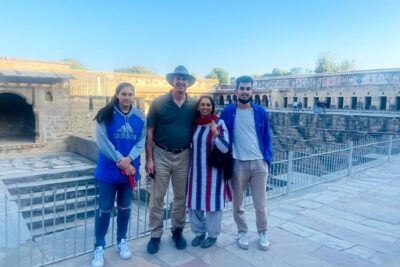
Private Transfer Agra To Jaipur Via Fatehpur Sikri & Chand Baori, Step Well
Read our review →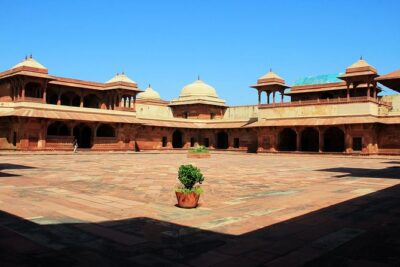
Agra To Jaipur Drop Via Fatehpur Sikri & Chand Baori, Step Well
Read our review →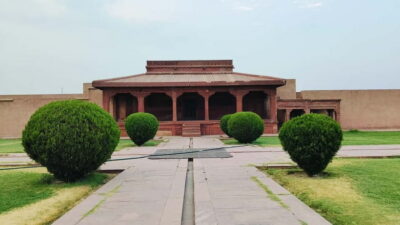
Browse the lists this tour appears in