
Reviewed · GOLDEN TRIANGLE TOURS
4 Days Private Golden Triangle Tour
The most powerful moment here is the sunrise visit to the Taj Mahal, reached after a private drive from Jaipur through Chand Baori and Fatehpur Sikri. In four days, you move through the Mughal and Rajput worlds of Jaipur, Agra, and Delhi without having to manage trains, taxis, or highway transfers yourself.
I like the private format, which lets your group adjust the pace, and I like that a driver, fuel, tolls, parking, and monument tickets are covered. The main drawback is the pace: Jaipur, Agra, and Delhi in four days means long road days and only a short taste of each city. Also, Udaipur is mentioned in the general description but does not appear in the day-by-day route, so confirm the plan before booking.
In This Review
- Key points at a glance
- Jaipur begins with palaces, instruments, and pink sandstone
- Chand Baori and Fatehpur Sikri break up the long drive
- The Taj Mahal is best handled before breakfast
- Delhi brings imperial avenues and older city details
- What the private car adds to the experience
- What the $400 price really covers
- The points I would confirm before booking
- Who should book this four-day route?
- FAQ
- How long is the Golden Triangle tour?
- Which cities are included in the scheduled route?
- Where can pickup take place in Jaipur?
- Is the Taj Mahal entrance included?
- What is included in the tour price?
- Where can the tour end?
- Can I cancel for a full refund?
- Should you book it?
Key points at a glance
- Taj Mahal at sunrise: A guided visit of about three hours, with entry included.
- Private door-to-door transport: Pickup is available from a Jaipur hotel, airport, railway station, or another agreed location.
- Three major cities in four days: Jaipur, Agra, and New Delhi form the actual route shown.
- Two worthwhile road stops: Chand Baori’s huge stepwell and Fatehpur Sikri break up the Jaipur to Agra drive.
- Flexible private touring: Your group travels alone, and past tour accounts describe drivers such as Manipal, Shiv Narayan Pal, and Sudhir as safe, punctual, and helpful.
- Important booking check: Udaipur appears in the broad description, but not in the listed four-day schedule.
Jaipur begins with palaces, instruments, and pink sandstone
Your first day starts with pickup anywhere in Jaipur, including a hotel, airport, railway station, or another desired address. That flexibility matters if you are arriving by train or flying in and want to begin sightseeing without arranging a separate transfer.
The Jaipur city tour gives you a quick but useful introduction to the Pink City. You visit Jal Mahal, the palace sitting in Man Sagar Lake, then continue to Jantar Mantar, the City Palace, and Hawa Mahal.
Jal Mahal is mainly a viewpoint stop. The palace sits in the middle of the lake, and the usual value is the photograph and the short introduction rather than a long interior visit. The schedule allows about 30 minutes, which is enough for a look but not a drawn-out stop.
At Jantar Mantar, allow the full hour. This collection of 19 large astronomical instruments was completed in 1734 under Sawai Jai Singh II, the ruler who founded Jaipur. The structures are easier to appreciate with a guide because their scale can seem odd until someone explains how they were used to track time and celestial positions.
The City Palace gives you the strongest sense of Jaipur’s royal past. It was established when the city was founded in 1727, after Sawai Jai Singh II moved his court from Amber. You have about an hour here, so expect a focused visit rather than every room and collection.
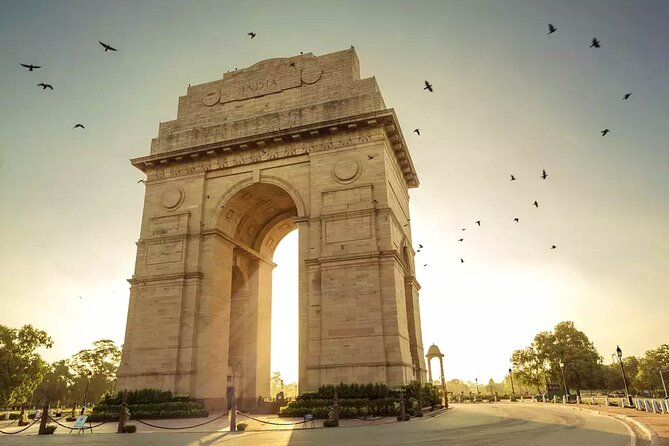
Hawa Mahal is a short stop, scheduled for about 30 minutes. Its red and pink sandstone facade was built in 1799 and extends from the City Palace toward the women’s quarters. The famous view is from outside, where the many small windows create the palace’s distinctive screen-like face.
This first day is well arranged for orientation, but it is not an in-depth Jaipur program. You do not see every major sight in the city, and the schedule does not list Amber Fort. If Amber is a priority, ask if the route can be adjusted. A private vehicle gives you a better chance of doing that than a fixed coach tour, though adding stops may reduce time elsewhere.
You spend the night in Jaipur. Breakfast is listed for two mornings, and two lunches are included, but hotel inclusion is not clearly stated in the supplied details. Confirm the hotel category and whether accommodation is included in the $400 price.
More Golden Triangle itineraries:
- Golden Triangle & Ranthambore: 4-Day Private Tour from Delhi
★ 5.0 · 355 reviews - From Delhi: Private 3-Day Golden Triangle Tour with Hotels
★ 4.9 · 339 reviews - From Delhi: Private 5-Day Golden Triangle Tour
★ 4.9 · 208 reviews
Chand Baori and Fatehpur Sikri break up the long drive
Day two is the road day. The schedule says that after breakfast you proceed from Jaipur toward Agra, with stops at Abhaneri and Fatehpur Sikri. One line mistakenly says proceed to Jaipur, but the sequence clearly places you in Jaipur and ends with arrival in Agra.
The Jaipur to Agra transfer is listed at about four hours before adding sightseeing. That estimate may feel tight once you include the stepwell, Fatehpur Sikri, traffic, and time for lunch or comfort stops. This is where the private car earns its keep. You are not tied to a large group, and you can discuss timing directly with the driver.
Chand Baori, at Abhaneri, is the more unusual stop. This massive stepwell dates from the eighth or ninth century and descends through about 3,500 steps. From above, its repeated stair patterns form a striking geometric design. The visit is scheduled for 30 minutes, enough to see the structure and take photographs.
You should treat the steps as a viewing feature, not a challenge to conquer. The point is the scale and design of the well, and the 30-minute stop keeps the day moving.
Fatehpur Sikri deserves more time, with about two hours scheduled. Founded by a 16th-century Mughal emperor, the former city is built largely in red sandstone. Buland Darwaza, the great gate leading toward Jama Masjid, is one of the major sights.
This stop adds useful context before Agra. You see a Mughal imperial center that was eventually abandoned, then continue to the city most closely linked with Mughal monument building. The drawback is simple: this is a full sightseeing and transfer day, so you may reach Agra tired.
After arrival, you check into your Agra hotel and stay overnight. Since the information provided does not specify hotel names or room standards, get those details in writing. A scheduled hotel check-in does not, by itself, confirm that lodging is included in the price.
The Taj Mahal is best handled before breakfast
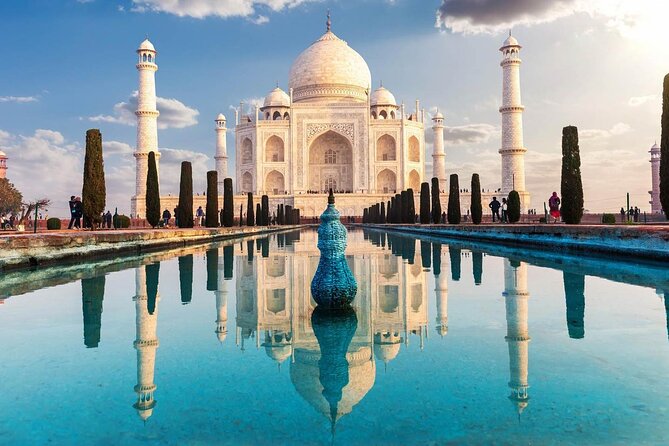
Day three begins with the tour’s headline event: the Taj Mahal at sunrise. The visit lasts about three hours, including a guided tour inside the monument, and the entrance ticket is included.
The early start is worth protecting. Morning light gives the white marble a softer appearance, and beginning here lets you see the monument before the rest of the day’s heat and traffic. The Taj Mahal is an ivory-white mausoleum on the southern bank of the Yamuna River, built by the Mughal emperor Shah Jahan.
Your guide is particularly useful inside the complex. The outside view is unforgettable, but the visit becomes more meaningful when you understand the building as a mausoleum and a work of design, symmetry, and memorial architecture. Keep your morning focused, since the schedule allows three hours for the entire visit.
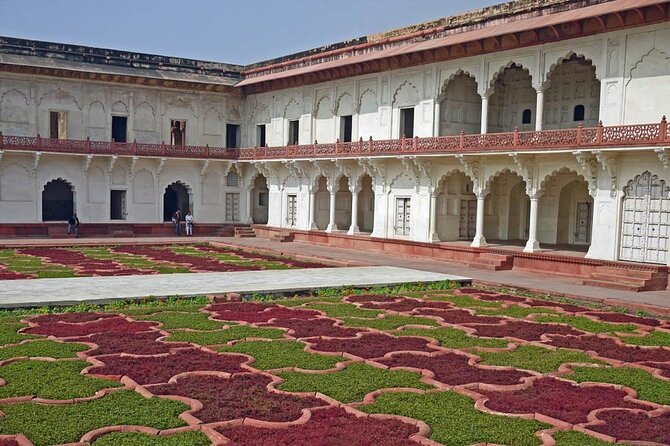
Agra Fort follows, with about two hours and entry included. This is not just a defensive wall. It was the main residence of the Mughal emperors until the capital moved from Agra to Delhi in 1638. The fort helps explain the political power behind the Taj Mahal, and it gives you a second, more substantial Mughal site rather than reducing Agra to one famous building.
The final Agra stop is the Tomb of Itimad-ud-Daulah, scheduled for 45 minutes. Often called the Baby Taj, this small mausoleum is known for its fine marble work and box-like proportions. It offers a quieter contrast to the scale and crowds associated with the Taj Mahal.
After the Agra sights, you drive to New Delhi and check into your hotel. The schedule assigns about three hours to this arrival segment, though traffic can affect the timing. This is another reason to avoid booking an important evening flight or fixed appointment unless you have plenty of room for delays.
The day combines three important monuments with an intercity transfer. That is efficient, but not restful. If you prefer slow mornings and long meals, this program may feel compressed. If your priority is seeing the headline sites in a short visit, the structure works well.
Delhi brings imperial avenues and older city details
The last day is a half-day guided tour of New Delhi. It begins with Qutub Minar, where you have about an hour and included admission.
Qutub Minar is a UNESCO World Heritage Site in the Mehrauli area. Its minaret reaches 72.5 meters and forms part of a wider historic complex. The one-hour stop gives you time to see the tower and the surrounding site, though it is not a full exploration of every feature.
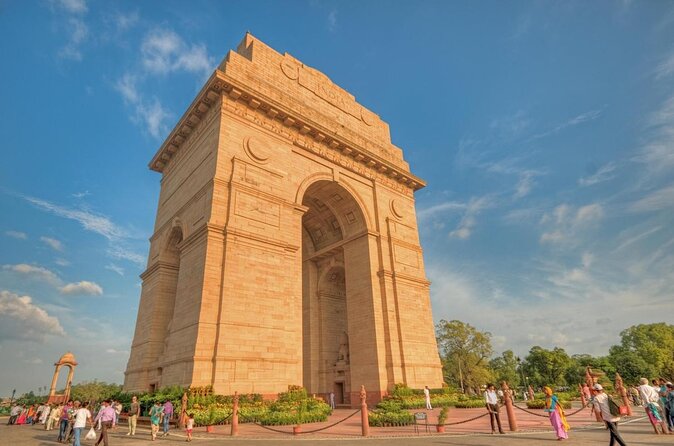
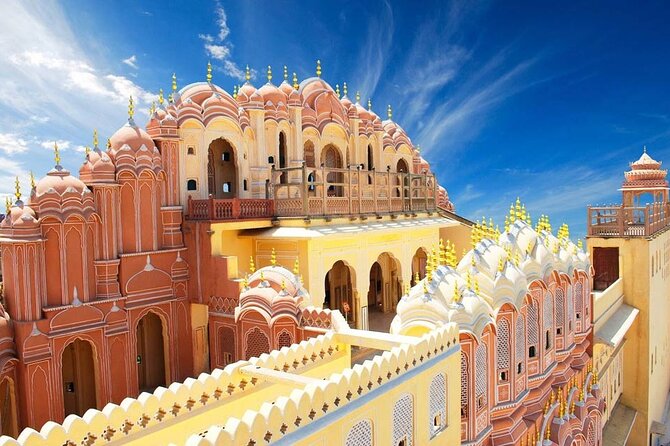
The rest of the Delhi tour is a series of short exterior and photo stops. India Gate receives about 15 minutes. This war memorial sits on the ceremonial axis of New Delhi, formerly called Kingsway.
You then see Parliament House and Rashtrapati Bhavan, the official residence of the President of India. Each stop is listed at 15 minutes. These are useful for seeing the planned governmental center of New Delhi, but you should expect views from outside rather than extended interior visits.
Agrasen Ki Baoli is the most distinctive final stop. This protected monument is a historic stepwell measuring about 60 meters long and 15 meters wide. Its enclosed stairway gives you a different look at Delhi from the grand government buildings and broad avenues.
The tour ends with drop-off at your desired location in Delhi, Noida, or Gurugram. That is practical if you are continuing to another hotel, airport connection, or business address, though the exact drop-off timing depends on the day’s traffic and your chosen destination.
A few more Jaipur tours worth weighing up
- From Delhi: Private 4-Day Golden Triangle Tour with Pickup
★ 4.6 · 38 reviews - 4 Days Golden Triangle Tour – Private, Guided & All Inclusive
★ 5.0 · 27 reviews - Private 4-Day Wildlife & Taj Mahal Tour from Jaipur to Delhi
★ 5.0 · 23 reviews - From Jaipur- 4 Day Private Jaipur & Agra Tour With Delhi Drop
★ 5.0 · 17 reviews
What the private car adds to the experience
The vehicle is described as a luxury air-conditioned car, with parking, tolls, fuel, and road tax included. On this route, those details matter. The distances between Jaipur, Agra, and Delhi are long enough that comfort and reliable transport affect the whole trip.
The private setup also gives you room to adjust the day. A couple traveling from Jaipur to Agra with driver-guide Manipal had flexibility to change plans, and the arrangement allowed them to feel safe during the journey. Another driver, Shiv Narayan Pal, is specifically praised for keeping passengers’ safety in mind during long drives through Rajasthan.
Sudhir is also noted for safe driving, a comfortable modern car, strong air-conditioning, and practical touches such as water and snacks. These details are not guaranteed for every departure, but they show the kind of service to clarify before you go. Ask for the driver’s name, vehicle type, and whether bottled water or snacks are supplied.
The private format is best for couples, families, and small groups who value control over the pace. It is less useful if you want long unplanned hours in each city, because the route still covers a lot of ground in four days.
What the $400 price really covers
At $400 per person, the package can offer reasonable value if the price includes the private car, driver, guides, monument tickets, meals, and hotel accommodation. The confirmed inclusions are the air-conditioned vehicle, entrance tickets, parking, tolls, fuel, road tax, two lunches, and two breakfasts.
The unclear point is lodging. The schedule includes hotel stays in Jaipur, Agra, and Delhi, but the supplied inclusion list does not clearly say that hotel rooms are part of the $400. Ask directly before paying. The same applies to the exact number of guided visits, since the schedule says you will have guided city tours but does not identify every guide.
Tips and personal costs are excluded. Budget separately for gratuities, drinks, extra meals, shopping, and anything else not listed. The package does not claim to cover every meal, so check which two lunches and two breakfasts are included.
The tour offers group discounts, which could improve the per-person value for a family or group of friends. Since it is a private activity, only your group participates. That means you are not paying for a seat on a large shared coach, but the value depends heavily on hotel quality and the clarity of the guide service.
The points I would confirm before booking
First, ask about Udaipur. The broad tour description refers to a Golden Triangle route that includes the city of lakes, but Udaipur is not present in the four-day schedule. The actual route provided is Jaipur, Agra, and Delhi. Adding Udaipur would require a major change in driving time and should not be assumed.
Second, confirm the hotels. Ask for names, star ratings, room type, and whether all three nights are included. The schedule mentions overnight stays, but the price details do not settle the matter.
Third, clarify the guide arrangement. The tour promises guided sightseeing, and past service has included drivers and guides who were friendly, punctual, and helpful. Names connected with the operator include Manipal, Shiv Narayan Pal, and Sudhir, but your assigned team may be different.
Fourth, protect the Taj Mahal morning. The sunrise visit is the strongest part of the trip, so make sure the pickup time, entry ticket, and guide meeting point are clear. Do not add a late-night plan in Agra if you want to enjoy this stop.
Free cancellation is available up to 24 hours before the start time for a full refund. Changes or cancellations made less than 24 hours before the start time are not accepted for a refund.
Who should book this four-day route?
I would recommend it to a first-time visitor who wants the essential sights with a private driver and limited planning work. It suits people arriving in Jaipur and departing from Delhi, since the route naturally finishes in the capital.
Families may appreciate the private vehicle and door-to-door pickup. Couples and small groups can benefit from adjusting the pace, especially on the long Jaipur to Agra day. The included monument tickets also make the cost easier to track.
I would be cautious if you dislike early mornings, long drives, or short stops. Jaipur and Delhi each receive only a partial look, while the road between cities takes a large share of the four days. You should also avoid booking until the Udaipur wording and hotel inclusions are cleared up.
FAQ
How long is the Golden Triangle tour?
The tour lasts approximately four days.
Which cities are included in the scheduled route?
The scheduled route covers Jaipur, Agra, and New Delhi. Udaipur is mentioned in the general description but is not included in the day-by-day schedule provided.
Where can pickup take place in Jaipur?
Pickup is available from a hotel, airport, railway station, or another desired location in Jaipur.
Is the Taj Mahal entrance included?
Yes. The Taj Mahal visit includes admission and a guided tour inside the monument, scheduled for about three hours.
What is included in the tour price?
The listed inclusions are a luxury air-conditioned vehicle, monument entrance tickets, parking, tolls, fuel, road tax, two lunches, and two breakfasts.
Where can the tour end?
Drop-off is available at a desired location in Delhi, Noida, or Gurugram.
Can I cancel for a full refund?
Yes, if you cancel at least 24 hours before the experience start time. Cancellations or changes made less than 24 hours beforehand are not accepted for a refund.
Should you book it?
Book this tour if you want the big three cities, a private car, a sunrise Taj Mahal visit, and a clear four-day framework. The strongest reasons are the included monument tickets, private transport, flexible pickup, and drivers with a record of safe, punctual service.
Before booking, settle the two loose ends: confirm that Udaipur is not part of the route unless a custom extension is arranged, and verify whether hotel rooms are included in the $400 price. With those details confirmed, this is a practical way to see northern India’s major sights without handling every transfer yourself.
Recently added around Jaipur
- Taj Mahal Entrance Ticket★ 5.0 · 3 reviews
- Jaipur: Ajmer & Pushkar Day Trip with Lunch & Camel ride★ 4.3 · 3 reviews
- Spiritual Private Tour of Vrindavan and Mathura★ 3.0 · 3 reviews
- Agra’s Hidden Gems & Flavors on a Thrilling Tuk-Tuk Tour 3-4 Hrs★ 5.0 · 3 reviews
- Jaipur: City Tour Full-Day Sightseeing with Guide★ 5.0 · 3 reviews
- Shop Agra Like a Local: Unique Indian Handicrafts Tour★ 5.0 · 3 reviews
- Agra: Taj Mahal and Agra Fort Private Guided Half-Day Trip★ 5.0 · 3 reviews
- From Jaipur: Taj Mahal Guided and Agra Tour By Car★ 5.0 · 3 reviews
Golden Triangle Tours, compared.
Golden Triangle & Ranthambore: 4-Day Private Tour from Delhi
Read our review →

Private 6-Day Golden Triangle Tour: Delhi, Agra, Jaipur by Car
Read our review →

4 Days Golden Triangle Tour – Private, Guided & All Inclusive
Read our review →Browse the lists this tour appears in