
Reviewed · GOLDEN TRIANGLE TOURS
Golden Triangle Tours
Delhi to Jaipur is one of India’s best first trips, and this six-day private tour covers the big three cities with a few worthwhile extras. You’ll see the Taj Mahal, Mughal tombs and forts, Jaipur’s royal complex, and the remarkable Chand Baori stepwell, all with a driver and local guides arranged along the way.
I like the private format, which lets you travel with only your own group and gives Raj Kumar Gupta room to adjust the plan around your budget and schedule. I also like the range of sights: the trip is not just a monument checklist, since Fatehpur Sikri and Chand Baori add two very different stops between Agra and Jaipur.
The main drawback is the pace. Six days includes long road journeys and several major sights, while some visits are brief. The listed $343 price is attractive for a private trip, but check exactly what it covers, especially hotels, entrance fees, meals, and airport transfers.
In This Review
- Key points about this six-day Golden Triangle trip
- What you are really buying for $343
- Day one in Delhi: a practical arrival day
- Delhi’s monuments, from Qutub Minar to Jama Masjid
- Day three: the Taj Mahal, Agra Fort, and Mehtab Bagh
- Day four: Fatehpur Sikri and the geometry of Chand Baori
- Day five in Jaipur: forts, palaces, and astronomical instruments
- The driving plan and guide support
- Who will enjoy this tour most
- Booking advice before you pay
- Should you book this Golden Triangle tour?
- FAQ
- How long is the Golden Triangle tour?
- Which cities does the tour visit?
- Is this a private tour?
- How many people are needed to book?
- Is hotel pickup available?
- Are monument admission fees included?
- What is the cancellation policy?
Key points about this six-day Golden Triangle trip
- Delhi, Agra, and Jaipur in one private journey: You cover India’s classic northern route without joining a larger group.
- Raj Kumar Gupta brings more than 20 years of driving experience: His background is in transporting international visitors around northern India and Rajasthan.
- A strong mix of famous and less expected sights: The Taj Mahal and Amber Fort share the schedule with Mehtab Bagh, Fatehpur Sikri, and Chand Baori.
- Local guides are used at major monuments: The plan calls for an English-speaking guide in Delhi, with guides also meeting you in Agra and Jaipur.
- The trip can be adapted: The operator says it can adjust the journey to suit your interests, budget, and available time.
- This is a demanding road trip: Some days combine several large sights, and the tour is not recommended for people with heart problems.
What you are really buying for $343
At about $343, this tour offers a low-cost way to arrange a private Golden Triangle route. The value comes less from luxury and more from having one company coordinate transport, hotels, guides, and the broad route between Delhi, Agra, and Jaipur.
The price needs careful checking before you commit. Several monument entries are marked as not included, including Qutub Minar, Humayun’s Tomb, the Red Fort, the Taj Mahal, Agra Fort, Mehtab Bagh, Amber Fort, the City Palace, and Jantar Mantar. Other stops are listed with free admission, but the page does not clearly spell out every hotel, meal, transfer, or vehicle detail.
That does not make the price poor. In fact, it can be good value if your hotel and private car are included at the advertised rate. It simply means you should ask for a written breakdown. A cheap tour can become less cheap once monument tickets and optional costs are added.
You also get a private experience rather than a shared coach trip. That matters in India, where road conditions, crowds, heat, and changing schedules can make a fixed group itinerary tiring. With only your own group, you can ask for a slower morning, a longer photo stop, or a change in emphasis, if the day’s timing allows.
More Golden Triangle itineraries:
- Golden Triangle & Ranthambore: 4-Day Private Tour from Delhi
★ 5.0 · 355 reviews - From Delhi: Private 3-Day Golden Triangle Tour with Hotels
★ 4.9 · 339 reviews - From Delhi: Private 5-Day Golden Triangle Tour
★ 4.9 · 208 reviews
Day one in Delhi: a practical arrival day
The first day is set aside for Delhi and hotel accommodation, with around 12 hours allocated to the stay. The plan does not list sightseeing on this day, so treat it as an arrival and settling-in period rather than a full touring day.
That is useful if you arrive tired or late. Delhi is a large city, and keeping the first day light can help you handle the next day’s packed schedule. Confirm the exact pickup point and hotel details before arrival, since the listed start time is 12:00 am and that wording can be confusing.
The tour offers pickup and a mobile ticket. It also says the route is near public transportation, though the main transport method for the private tour appears to be the arranged vehicle. At least two people must book, so this is not designed for a solo participant booking alone.
Delhi’s monuments, from Qutub Minar to Jama Masjid
Day two is the most crowded sightseeing day. You begin with Qutub Minar, where an English-speaking guide is scheduled to meet you. The listed visit is only 30 minutes, which is enough for an introduction and photographs but short for a careful look at the complex.
Qutub Minar is one of Delhi’s defining monuments, with a tall stone tower and remains of an early Islamic complex around it. Your guide is especially useful here because the site’s meaning is not obvious from a quick walk. If you care about architecture and early Delhi, ask whether the timing can be extended.
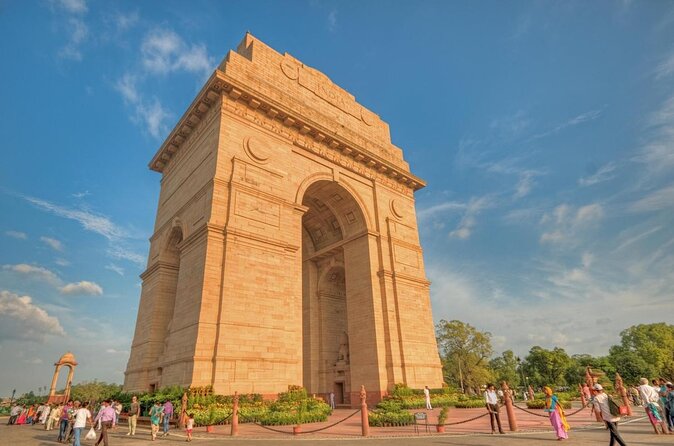
The route then includes India Gate, the All India War Memorial on Rajpath. It is presented as a stop without a stated duration, so you should expect a photo visit rather than a long museum-style session.
Next comes Humayun’s Tomb, the Mughal emperor’s final resting place and the first garden tomb in the Indian subcontinent. The planned 30 minutes is again brisk. I would use this time to focus on the building’s layout, symmetry, and garden setting instead of trying to see every corner.
The Red Fort receives 45 minutes. This former Mughal residence is one of Old Delhi’s major sights, but the listed time is not enough for a slow exploration of the entire complex. You will get the main impression, though, and the guide can help you understand how the fort fits into Delhi’s Mughal story.
The Lotus Temple follows, with a 30-minute visit and free admission listed. Its flower-shaped design makes it a clear change of pace after the red sandstone and Mughal sites. The temple is a Baháʼí House of Worship, dedicated in 1986, and the visit is more about quiet space and striking form than a traditional collection of images or objects.
Jama Masjid closes the day’s sightseeing. This large mosque was built under Shah Jahan between 1650 and 1656. A 30-minute stop gives you a look at the scale and setting, but modest clothing and respectful conduct are important at a working religious site.
This is a lot for one day. The benefit is that you see a broad slice of Delhi, from medieval towers to modern memorial architecture. The cost is limited time at each place and a long day on the road between stops.
Day three: the Taj Mahal, Agra Fort, and Mehtab Bagh
The third day centers on Agra, with the Taj Mahal receiving about two hours. That is the right place to give the schedule its longest single visit. Your guide is supposed to meet you at the hotel and lead the city tour, though the exact guide is not named in the plan.
The Taj Mahal is more than a quick photograph. Two hours gives you time to approach the main building, take in the changing view as you walk closer, and visit the central areas at a measured pace. Entrance is not listed as included, so ask about the current ticket arrangement and any separate charges before the day begins.
Agra Fort follows for about an hour. The fort offers a useful contrast to the Taj Mahal. Instead of a single marble mausoleum, you move through a large fortified complex tied to the Mughal rulers. The one-hour plan should cover the main sections, but you may want to agree in advance on which parts matter most to you.
Mehtab Bagh gets 30 minutes. This garden across the Yamuna River is valued for its view toward the Taj Mahal, especially as a calmer alternative to the main monument grounds. Since admission is listed as not included, confirm the ticket cost. The stop is short, but it gives your day a different angle and breaks up the fort visit.
Agra is where a good guide can make a real difference. The monuments are impressive on their own, yet a clear explanation helps you connect the Taj Mahal, Agra Fort, and the Mughal court that shaped both sites. The operator has arranged English-speaking guides and drivers for past tours, with team members such as Nikhileshh, Jitendra, Himmat, and Arvind associated with different bookings. Your assigned staff may differ, so request names and contact details before departure.
A few more Jaipur tours worth weighing up
- Jaipur: Private Full Day Sightseeing Tour By Car with Guide
★ 4.9 · 1,839 reviews - 3-Hour Morning Bike Tour of Jaipur
★ 5.0 · 1,253 reviews - Jaipur: Private Sightseeing Day Tour with Guide by Car
★ 4.8 · 773 reviews - Jaipur: Private Full-Day Sightseeing Tour by Tuk-Tuk
★ 4.8 · 573 reviews
Day four: Fatehpur Sikri and the geometry of Chand Baori
The fourth day is a welcome change from city monuments. Fatehpur Sikri, west of Agra, receives about two hours. This former Mughal city is built largely in red sandstone, and its compact group of buildings makes it easier to grasp than a sprawling urban site.
Buland Darwaza provides a dramatic entrance to the Jama Masjid mosque area. Nearby buildings include marble and red sandstone elements, giving the complex a different feel from Agra’s main monuments. Two hours allows you to move beyond a single photograph and notice the way courtyards, gateways, and palace spaces fit together.
The schedule then takes you to Chand Baori in Abhaneri, a village in Rajasthan. The stepwell reaches roughly 30 meters below ground and is one of India’s deepest and largest. You get about 30 minutes here, enough to see the striking repeated steps and understand the scale, though not enough for a slow village visit.
This is one of the strongest choices in the route. Chand Baori is not simply another palace or fort. Its design shows how practical water storage could also produce an ordered, almost mathematical structure. The short stop is the drawback, especially if you enjoy photography or want more time in the surrounding area.
Day five in Jaipur: forts, palaces, and astronomical instruments
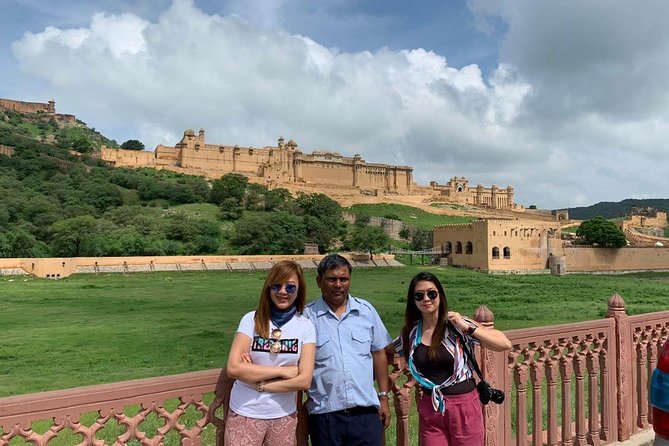
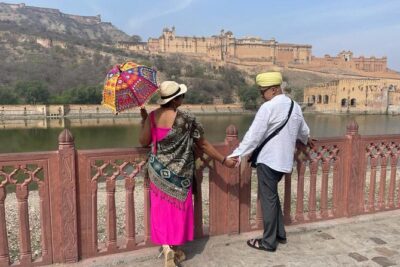
Jaipur receives the fifth day, beginning with Amber Fort, about 11 kilometers from the city. The visit lasts around 90 minutes. Amber, also called Amer Fort, was built by Rajput rulers and sits in the town of Amer, which has an area of about four square kilometers.
The fort is the day’s major sight. Expect courtyards, defensive walls, royal rooms, and views over the surrounding area. Ninety minutes is workable but fast. If you want detailed explanations of the rulers, rooms, or decorative work, stay close to your guide and decide which sections to prioritize.
Jal Mahal is a 10-minute photo stop. The palace sits in Man Sagar Lake and was first constructed in 1699, with later work enlarging and renovating the building and lake. The short visit means you will mainly see it from the roadside viewpoint rather than tour the interior.
The City Palace follows for about 90 minutes. It was established when Jaipur was founded in 1727 by Maharaja Sawai Jai Singh II, who moved the court from Amber. This is an important stop for understanding how Jaipur developed as a planned royal city, and the time allowance gives you a reasonable first look at its courtyards and palace buildings.
Jantar Mantar is scheduled for 30 minutes. This collection of 19 astronomical instruments was built by Sawai Jai Singh II and completed in 1734. It includes the world’s largest stone sundial, and a guide is useful here because the instruments can look like abstract sculptures unless someone explains how they measure time and track the sky.
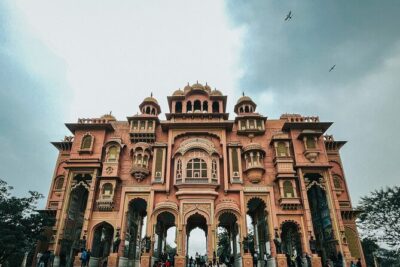
Hawa Mahal is also included, though no duration is specified. Its pink and red sandstone facade is one of Jaipur’s familiar images. The palace adjoins the City Palace area and extends toward the Zenana, or women’s chambers. Confirm whether this is an exterior photo stop or an interior visit, since the itinerary does not say.
Jaipur’s day is full but better balanced than Delhi’s. You get a fort, lake palace, royal complex, scientific site, and famous facade. The downside is that most visits are timed tightly, so this suits you if you want broad coverage more than long, unhurried museum visits.
The driving plan and guide support
The operator is led by Raj Kumar Gupta, who says he has worked in tourism for more than 20 years as a driver in northern India and Rajasthan. That experience matters on a route where the road days are almost as important as the monuments. Raj also says he works with visitors from many countries and can adapt a trip around your interests, budget, and time.
The tour is private, but it is not a fully private guiding arrangement at every minute. The plan specifically calls for an English-speaking guide in Delhi and guides in Agra and Jaipur, while the driver handles the longer transfers. Ask whether the same driver stays with you throughout and whether guides are licensed or locally assigned.
Past arrangements connected with the operator have included prompt WhatsApp communication, punctual drivers, safe driving, and strong English support. Names associated with the team include Jitendra, Himmat, Arvind, and Nikhileshh. These details are useful when planning, but they do not guarantee who will be assigned to your booking.
Who will enjoy this tour most
I would recommend this route to a first-time visitor who wants the classic Golden Triangle without arranging every car, hotel, and guide separately. It also suits couples, families, and friends who value privacy and want some say in the daily plan.
It is less suitable if you prefer slow travel. Delhi’s second day is packed, Agra’s three major stops are tightly timed, and Jaipur gives you only one full sightseeing day. The tour is also not recommended for people with heart problems, and anyone concerned about long road journeys should ask for the approximate driving times.
At least two people are required to book. Pickup is offered, airport drop-off can be arranged in Delhi or Jaipur, and the experience is described as suitable for most people, but the physical demands of heat, walking, steps, and busy sightseeing days should still be considered.
Booking advice before you pay
Ask for the hotel names and room category, since accommodation is listed but not described in detail. Also ask whether the $343 rate includes the private vehicle, fuel, driver expenses, guide fees, monument tickets, meals, and airport transfer.
Clarify the first and last points of the journey. The final drop-off may be at a Delhi or Jaipur airport, but you should confirm which airport matches your flight and whether the transfer is included. The start time shown is midnight, so get the actual pickup time in writing.
The cancellation terms are fairly firm. You can receive a full refund if you cancel at least three full days before the local start time. Later cancellations and changes are not accepted, and poor weather or failure to reach the minimum group size can lead to a different date or a refund.
Should you book this Golden Triangle tour?
Book it if you want the famous Delhi, Agra, and Jaipur route handled by one private operator, with room to request changes and a driver familiar with northern India. The best parts are the efficient coverage, the useful mix of major monuments and Chand Baori, and the chance to communicate directly with Raj.
Before booking, get the inclusions in writing. At $343, the tour can be a strong value, but the many separate admission fees and unclear hotel details make that confirmation essential. If you accept a fast pace and want a broad first look at the Golden Triangle, this is a sensible choice. If you want long visits, quiet mornings, or extensive time inside each monument, plan a longer custom trip instead.
FAQ
How long is the Golden Triangle tour?
The tour lasts approximately six days.
Which cities does the tour visit?
It visits Delhi, Agra, and Jaipur, with stops at Fatehpur Sikri and Chand Baori between Agra and Jaipur.
Is this a private tour?
Yes. Only your own group participates in the private tour or activity.
How many people are needed to book?
A minimum of two people is required.
Is hotel pickup available?
Pickup is offered. The tour information does not specify every pickup location, so confirm your hotel or arrival point before booking.
Are monument admission fees included?
Several admission fees are specifically listed as not included, including the Taj Mahal, Agra Fort, Amber Fort, City Palace, and Jantar Mantar. Other stops are listed as free admission. Ask for a complete ticket breakdown.
What is the cancellation policy?
You can cancel for a full refund if you do so at least three full days before the local start time. Cancellations or changes made later are not accepted. If bad weather or insufficient bookings cancel the experience, you will be offered another date or a full refund.
Recently added around Jaipur
- Taj Mahal Entrance Ticket★ 5.0 · 3 reviews
- Jaipur: Ajmer & Pushkar Day Trip with Lunch & Camel ride★ 4.3 · 3 reviews
- Spiritual Private Tour of Vrindavan and Mathura★ 3.0 · 3 reviews
- Agra’s Hidden Gems & Flavors on a Thrilling Tuk-Tuk Tour 3-4 Hrs★ 5.0 · 3 reviews
- Jaipur: City Tour Full-Day Sightseeing with Guide★ 5.0 · 3 reviews
- Shop Agra Like a Local: Unique Indian Handicrafts Tour★ 5.0 · 3 reviews
- Agra: Taj Mahal and Agra Fort Private Guided Half-Day Trip★ 5.0 · 3 reviews
- From Jaipur: Taj Mahal Guided and Agra Tour By Car★ 5.0 · 3 reviews
Golden Triangle Tours, compared.
Golden Triangle & Ranthambore: 4-Day Private Tour from Delhi
Read our review →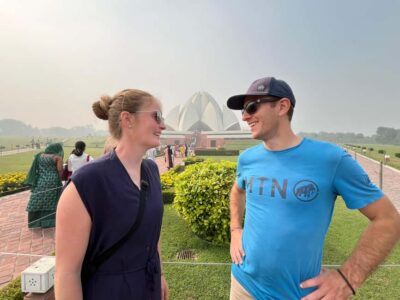

Private 6-Day Golden Triangle Tour: Delhi, Agra, Jaipur by Car
Read our review →
4 Days Golden Triangle Tour – Private, Guided & All Inclusive
Read our review →
Explore Private Tour The Golden Triangle Done Differently
Read our review →Browse the lists this tour appears in