
Reviewed · WALKING TOURS
Evening Walking tour with Fire Ceremony – The Pushkar Route
Pushkar’s most moving moment comes after sunset, when temple bells ring around the lake and flames rise during the Maha Aarti fire ceremony. This three-hour walk takes you through Pushkar’s temples, ghats, and quieter lanes while a local guide explains the customs behind what you see.
I like the shopping-free format, which keeps the evening focused on religion and local life. I also like the small group limit of six, and guides such as Manish and Kapil are praised for friendly, clear explanations and for answering questions beyond the usual route.
The main consideration is that this is a walking tour built around religious sites, so it may not suit anyone who finds three hours on foot tiring. The two Brahma Ghat visits also overlap, since the first includes the area and the later stop centers on the Aarti itself.
In This Review
- Key points of the Pushkar evening walk
- Why Pushkar changes after sunset
- Brahma Ghat and the fire ceremony
- Brahma Temple and Pushkar’s unusual religious importance
- Varaha Temple and the town’s older shrines
- Gurudwara Sahib and Pushkar’s religious mix
- Walking around all 52 ghats of Pushkar Lake
- Old Rangji Temple near Varaha Ghat
- What the guide adds to the walk
- Is $8 good value for three hours?
- Who should book this Pushkar evening tour?
- Booking, cancellation, and practical details
- Should you book The Pushkar Route?
- FAQ
- How long does the Evening Walking Tour with Fire Ceremony last?
- What time does the tour begin?
- What places does the tour visit?
- Is the fire ceremony included?
- How many people can join the tour?
- Can I cancel for a full refund?
Key points of the Pushkar evening walk
- Maha Aarti at Brahma Ghat: Watch Pushkar’s evening fire ritual beside the lake, with temple bells and chants adding to the atmosphere.
- Seven religious and historic stops: See Brahma Temple, Varaha Temple, Gurudwara Sahib, Old Rangji Temple, and several sections of Pushkar Lake.
- A 52-ghat lake walk: Follow the water’s edge and visit small temples along the lake.
- A shopping-free evening: The route is designed around spirituality, customs, architecture, and local explanations rather than sales stops.
- Small groups of six: A compact group makes it easier to ask questions about Hindu traditions and Pushkar’s sacred sites.
- Good value at $8: For about three hours, with admission included at the listed stops, the price is modest for a guided introduction to Pushkar after dark.
Why Pushkar changes after sunset
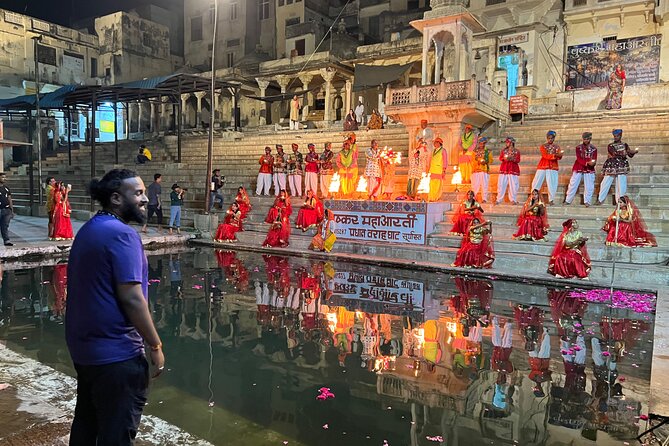
Pushkar can feel lively and colorful during the day, but evening brings a different mood. As daylight fades, the lakefront becomes quieter, temple bells carry through the town, and the ghats take on a more reflective feel.
The tour starts at 5:00 pm and lasts about three hours. That timing is important. You are not simply walking through empty streets at night. You are moving through the town during the transition from late afternoon to evening, ending with the religious ceremony that gives the experience its main focus.
I like this approach because Pushkar is not only a place to look at. It is a living religious center, and the evening rituals help explain why the lake and surrounding temples matter. A guide can also help you understand customs that would be easy to miss if you walked alone.
The experience is capped at six people. That is a real advantage here. A guide such as Manish or Kapil can respond to individual questions, explain Hindu beliefs in plain language, and point out small places that are easy to pass without noticing. The compact group also makes it easier to stay together on foot.
More Walking Tours in Pushkar
- Spiritual City Walking Tour-THE Pushkar Route
★ 5.0 · 907 reviews - Afternoon Walk Tour with Sunset & Fire Ritual -The Pushkar Route
★ 5.0 · 119 reviews - Evening Walking Tour with Fire Rituals-The Pushkar Route
★ 4.9 · 108 reviews
Brahma Ghat and the fire ceremony
Brahma Ghat is the emotional center of the route. It is one of the important ghats beside Pushkar Lake and is known for the Maha Aarti, the evening fire ceremony.
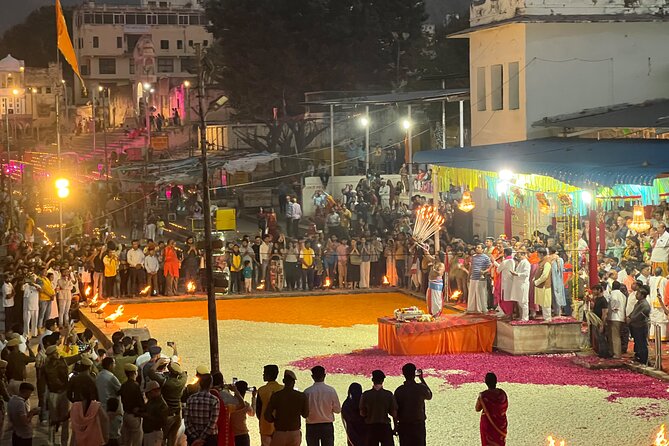
Aarti is a Hindu ritual involving lamps or flames offered as part of worship. At Pushkar, the ceremony takes place by the lake, where the sound of bells and the glow of fire create a strong sense of place. You do not need to be a religious visitor to appreciate the ritual. The value comes from seeing an active custom in its proper setting, rather than watching a performance arranged for sightseeing.
The route lists Brahma Ghat twice. The first visit allows time to understand the ghat and its setting, including the temple associated with Shankaracharya near the entrance. The second visit focuses on the evening Aarti, with about 25 minutes set aside for the ceremony.
That repeated stop is not necessarily a flaw. The ghat looks and feels different as daylight fades, and the later visit gives the ritual its own place in the schedule. Still, if you prefer a route with no repeated locations, this structure may feel slightly less varied.
You should treat the ceremony as a religious event first and a photo opportunity second. The supplied details do not specify photography rules, so follow the guide’s instructions and be respectful around worshippers.
Brahma Temple and Pushkar’s unusual religious importance
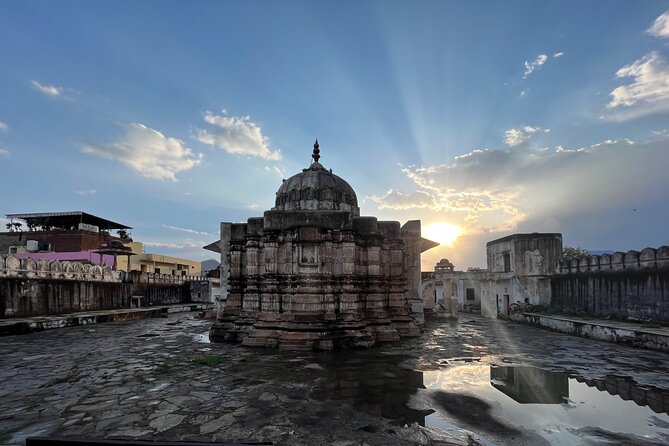
The next major stop is Brahma Temple, one of the very few temples in India dedicated to Brahma, the Hindu creator god. That fact alone makes it an important stop for anyone interested in Hindu traditions.
The structure dates to the 14th century, with later repairs and changes. The guide can put the building into context and explain why Brahma, despite his place in Hindu belief, has comparatively few major temples dedicated to him.
The scheduled visit lasts around 30 minutes, with admission included. That gives you enough time to see the temple and ask questions without turning the evening into a long architectural lecture.
This is one place where a guide adds clear value. Temple symbolism and worship customs can be hard to interpret from the outside, especially when you are unfamiliar with Hindu practice. The strongest part of the tour is not just entering a historic building, but connecting it to the beliefs that make Pushkar sacred.
Temple access can depend on local rules and worship activity, so keep an open mind about the exact pace of this stop. The tour description includes the visit and admission, but it does not promise a private viewing or special access.
Varaha Temple and the town’s older shrines
Varaha Temple introduces another side of Pushkar’s religious story. It is dedicated to Varaha, an incarnation of Lord Vishnu, and is described as one of the oldest temples in the town.
The temple dates to the 12th century and was built by King Anaji Chauhan. It is also considered one of Vishnu’s eight Swayambhu Kshetra, a sacred group associated with self-manifested forms of the deity.
You get about 25 minutes here. That is enough for a focused visit, especially when the guide explains what you are seeing. The stop adds variety after Brahma Temple because it shifts attention from Brahma to Vishnu and shows how several strands of Hindu worship meet in one small town.
Do not expect every stop to feel like a major monument. Some of the appeal is the contrast between famous temples and smaller religious places woven into the streets. If you want only grand architecture, the route may feel modest. If you want a sense of how religion shapes daily space in Pushkar, this is a useful part of the walk.
A completely different kind of day out from Pushkar:
- Spiritual Walking tour with Puja Ceremony -The Pushkar Route
★ 5.0 · 101 reviews - Walking Sightseeing Tour – The Shine Pushkar
★ 5.0 · 64 reviews - Pushkar Day Trip from Jaipur – Private Car, Safari, Guide & Lunch
★ 4.5 · 45 reviews - From Jaipur : Private Ajmer Pushkar Tour by Cab
★ 4.5 · 29 reviews
Gurudwara Sahib and Pushkar’s religious mix
Gurudwara Sahib is a Sikh temple, and its inclusion gives the tour a wider frame. Pushkar is often associated first with Hindu pilgrimage, Brahma Temple, and the lake, but this stop shows the town’s religious diversity.
The gurdwara is described as peaceful and attractive, with about 30 minutes allotted for the visit. Your guide can explain the Sikh presence in Pushkar and help you compare the atmosphere and customs here with those of the Hindu temples.
I especially like this stop because it prevents the experience from becoming a narrow tour of one tradition. You get a look at the way different faiths share the same town, streets, and pilgrimage setting.
As with the Hindu temples, respectful behavior matters. Dress and conduct should suit a religious place, and you should follow any instructions given on arrival. The supplied details do not specify a dress code, so ask your guide if you are unsure.
Walking around all 52 ghats of Pushkar Lake
The lake walk is the most scenic part of the route. Pushkar Lake is surrounded by 52 ghats, and the tour follows sections of the water with stops at small, old temples along the edge.
This is where the three-hour format makes sense. You are not rushing from one major attraction to the next in a vehicle. You are seeing how the ghats connect, noticing changes in the light, and getting a sense of the lake as the center of Pushkar’s religious life.
The description includes photography spots, but this is not presented as a dedicated photo tour. Bring a phone or camera if you like, but do not let it distract from the ritual setting. The lake, temple edges, bells, and evening light are likely to be more memorable than a checklist of pictures.
Walking around the ghats can also be the least predictable part of the evening. The route covers old streets and religious areas, and the information does not specify the exact walking distance or surface conditions. Wear comfortable shoes and expect the tour to feel like a genuine town walk rather than a polished attraction with smooth paths throughout.
Old Rangji Temple near Varaha Ghat
Old Rangji Temple is a smaller final temple stop, located near Varaha Ghat in the middle of Pushkar. It is about 200 years old and dedicated to Lord Vishnu.
Only 15 minutes are scheduled here, so expect a short introduction rather than a long visit. Its position near Varaha Ghat helps tie the route together geographically, while its Vishnu connection adds another layer to the religious picture.
This stop may be most useful for people who enjoy details and comparisons. You will have already seen Brahma and Varaha-related sites, plus a Sikh gurdwara. Old Rangji Temple gives the guide one more chance to explain how different shrines fit into Pushkar’s compact religious center.
The route does not promise access to every interior area at every temple. The listed stops and included admissions tell you what the tour is designed to cover, but religious sites can operate on their own schedule.
What the guide adds to the walk
The guide is central to the value of this experience. Without explanation, you would still see attractive ghats, temples, bells, and evening lights. With Manish or Kapil, you can ask why a temple matters, how a ceremony works, and how Hindu traditions relate to the places around you.
The strongest praise is directed at the guides’ friendliness, clear information, and willingness to answer questions outside the standard routine. That matters if you are curious about Hinduism rather than simply looking for a quick evening stroll.
Manish is described as welcoming and informative. Kapil is praised for explaining key Pushkar temples and Hindu beliefs in a way that encourages questions. Guide assignments can change, so you should not assume one specific person is guaranteed unless the booking details confirm it.
The small group limit supports this style of guiding. Six people is large enough to share the experience but small enough for a real conversation. It also suits solo visitors and couples who want more context than a self-guided walk provides.
Is $8 good value for three hours?
At $8 per person, this is an inexpensive way to spend an evening in Pushkar. You receive about three hours of guiding, visits to several religious sites, the lake walk, and the fire ceremony. Admission is included at the listed stops.
The price is especially good if you were already planning to see Brahma Temple and Pushkar Lake. A local guide adds interpretation, helps connect the sites, and takes you to less-visited temples that you might struggle to find on your own.
The value is less about luxury and more about access to context. This is not a vehicle tour, a private ceremony, or a premium food experience. It is a small-group walking route through sacred parts of town.
Pickup is offered, and the activity is near public transportation. Since the stated start time is 5:00 pm and the exact pickup details are not provided, confirm where you should meet and how pickup works before setting out.
The activity is currently rated 4.9 from 35 ratings, with 97 percent recommending it. Those numbers fit the experience’s strongest features: friendly guiding, useful explanations, and a well-chosen evening setting. They should not be read as a promise that every temple visit will follow the same pace, since religious sites can have changing conditions.
Who should book this Pushkar evening tour?
I would choose this walk if you want a first introduction to Pushkar’s religious life and prefer explanations over aimless wandering. It is also a good fit if you are interested in Hindu customs, temple architecture, Sikh culture, or the way several religious traditions share one small town.
The tour suits solo visitors particularly well because the group is small and the guide provides company during the evening. Couples and families who enjoy cultural visits should also find the format useful.
You should think twice if you dislike walking, want a fast-paced sightseeing tour, or prefer to explore only major monuments. The route includes several temples and ghats, and some stops are short. Its appeal comes from the overall sequence, not from spending a long time at one spectacular building.
You should also be comfortable visiting active religious places. The Aarti is not staged for the tour, and the temples are places of worship. Respect, patience, and sensible clothing will help you get more from the evening.
Booking, cancellation, and practical details
Confirmation is provided when you book, and mobile tickets are accepted. Most people can take part, though the information does not give a detailed accessibility description, walking distance, or surface report.
The experience offers free cancellation up to 24 hours before the local start time for a full refund. Cancellations or changes made within 24 hours are not refunded or accepted.
Because the tour is often booked about 19 days ahead, reserving early is sensible if your Pushkar dates are fixed. The six-person limit can make the experience feel personal, but it also means availability may be tighter than for a large group walk.
Should you book The Pushkar Route?
Book it if you want Pushkar after dark to mean more than a stroll through attractive lanes. The Brahma Ghat Aarti, the lake’s 52 ghats, and the mix of Brahma, Vishnu, and Sikh religious sites give the evening real substance.
At $8, the tour offers strong value, especially with admission included and a maximum of six people. Manish and Kapil are both praised for warmth, clear explanations, and thoughtful answers, which is exactly the kind of guide support that helps at unfamiliar temples.
Skip it if you need a low-walking activity, dislike religious ceremonies, or want a route with no repeated stop. For most curious visitors, though, this is a practical and affordable way to understand why Pushkar matters.
FAQ
How long does the Evening Walking Tour with Fire Ceremony last?
The tour lasts approximately three hours.
What time does the tour begin?
The stated start time is 5:00 pm.
What places does the tour visit?
The route includes Brahma Ghat, Brahma Temple, Varaha Temple, Gurudwara Sahib, Pushkar Lake, Old Rangji Temple, and a second visit to Brahma Ghat for the evening Aarti.
Is the fire ceremony included?
Yes. The tour includes the evening Maha Aarti, or fire ceremony, at Brahma Ghat beside Pushkar Lake.
How many people can join the tour?
The activity has a maximum of six participants.
Can I cancel for a full refund?
Yes. You can cancel at least 24 hours before the local start time for a full refund. Cancellations or changes made within 24 hours are not accepted and are not refunded.
More Evening Tours in Pushkar
- Camel Desert Safari with Sunset -The Pushkar Route
★ 5.0 · 8 reviews - Pushkar: Camel Sunset Safari Adventure
★ 3.5 · 7 reviews - Taj Mahal Sunrise & Sunset All Inclusive Private Luxury Agra Tour
★ 5.0 · 348 reviews - Experience Jaipur By Night
★ 5.0 · 215 reviews
Recently added around Pushkar
- Jaipur: Ajmer & Pushkar Day Trip with Lunch & Camel ride★ 4.3 · 3 reviews
- Private Day Trip to Pushkar From Jaipur★ 4.5 · 3 reviews
- Explore Chittorgarh Fort With Udaipur Drop from Pushkar★ 5.0 · 4 reviews
- Rajasthan tours: Luxury and private tour by car with guide.★ 4.8 · 4 reviews
- Food & Culture Walking Tour – The Pushkar Route★ 5.0 · 4 reviews
- Private Day Trip to Holy City of Pushkar from Jaipur★ 5.0 · 4 reviews
- From Jaipur: One-Day Trip From Jaipur to Pushkar★ 3.8 · 4 reviews
- Travel From Jaipur To Jodhpur Via Ajmer And Pushkar★ 3.5 · 5 reviews
Walking Tours, compared.

Afternoon Walk Tour with Sunset & Fire Ritual -The Pushkar Route
Read our review →
Evening Walking Tour with Fire Rituals-The Pushkar Route
Read our review →Browse the lists this tour appears in