
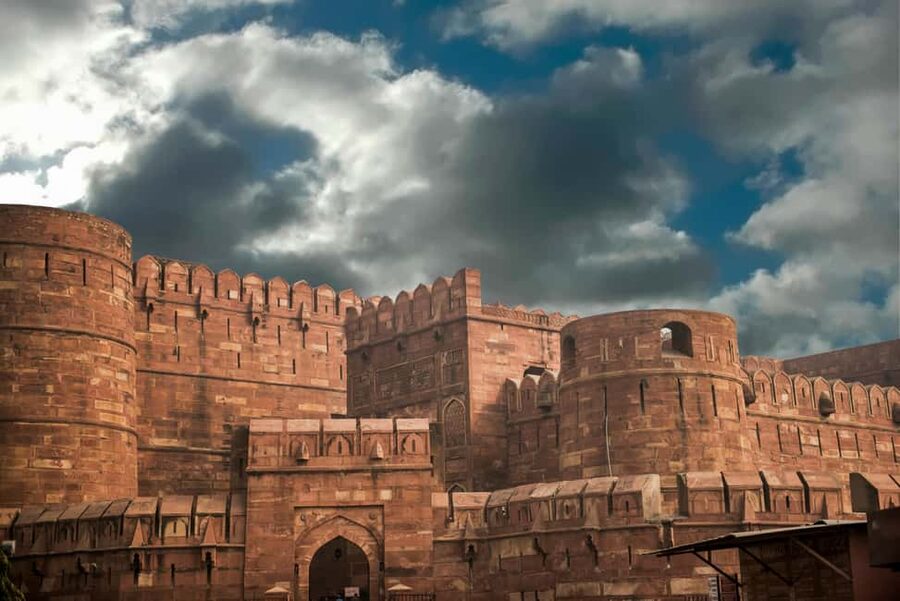
Reviewed · AGRA FORT TOURS
Agra Fort: Guided UNESCO Heritage Walking Tour
Agra Fort is more than a stop before the Taj Mahal. Inside its red sandstone walls, you move from military gate to royal court, private palace, prison chamber, and garden. The most moving sight is Musamman Burj, where Shah Jahan spent his last years looking toward the Taj Mahal.
I like the private-group format, which lets the guide set a sensible pace, and I like the very low price: $6 buys you a focused hour with someone who can explain what plain stone walls and grand halls once meant. The main consideration is time. Agra Fort is huge, and one hour gives you a strong introduction rather than a complete visit.
I also like that guides such as Gagan and Shahid Khan have helped with photos, meeting instructions, busy entrance areas, and avoiding unwanted photographers and vendors. You still need comfortable shoes, patience at the security check, and a small bag, since the fort has uneven surfaces and walking between its major sights takes effort.
In This Review
- Key points to know before entering Agra Fort
- Why Agra Fort deserves more than a quick photo stop
- Amar Singh Gate: the practical start of the tour
- The fort’s military face and Mughal design
- Diwan-i-Am: where the emperor met his subjects
- Diwan-i-Khas and Jahangiri Mahal
- Musamman Burj and the view toward the Taj Mahal
- The mirrored palace and Anguri Bagh
- What the one-hour schedule really gives you
- Guide quality and the value of local help
- Who should book this Agra Fort tour?
- Should you book it?
- FAQ
- How long does the Agra Fort guided tour last?
- How much does the tour cost?
- Is this a private tour?
- Which languages does the guide speak?
- Is transportation included?
- Where do I meet the guide?
- Which parts of Agra Fort are included?
- Can I take photographs?
- What should I bring?
- Can I visit the Taj Mahal on the same day?
Key points to know before entering Agra Fort

- Shah Jahan’s final view: Musamman Burj offers the tour’s most personal historical moment, with a view toward the Taj Mahal.
- A private one-hour visit: You receive a guide for your group rather than joining a large shared crowd.
- The royal rooms matter: Diwan-i-Am, Diwan-i-Khas, and Jahangiri Mahal show how the fort worked as both court and residence.
- The mirrored palace may be accessible: Its reflective interior is a memorable bonus, but access can vary.
- Helpful photo stops: Guides including Gagan and Shahid Khan have been praised for taking photos at good viewpoints.
- Easy pairing with the Taj Mahal: The Taj is about 2.5 kilometers away, so both sights can fit into the same day.
Why Agra Fort deserves more than a quick photo stop
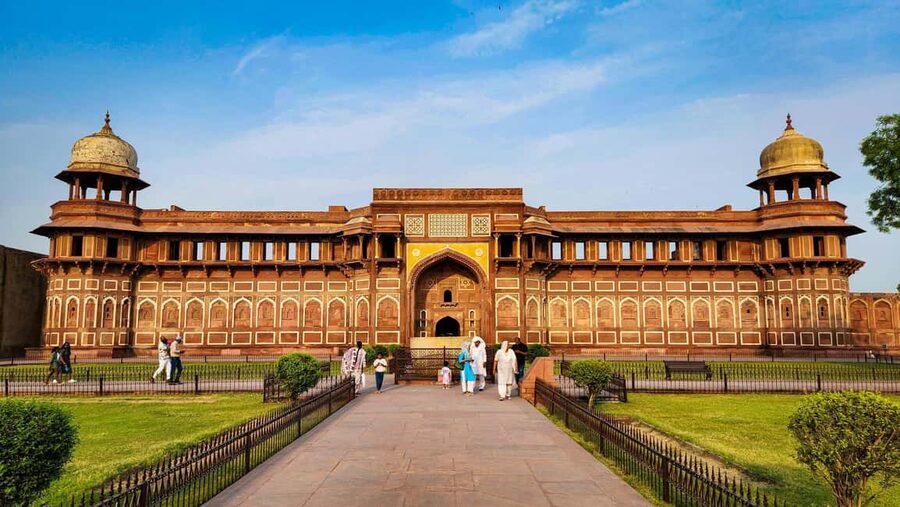
Agra Fort can look like a red sandstone fortress from the outside, but that first impression misses half the story. It was a military stronghold, an imperial residence, a place of government, and a controlled world of courtyards, halls, balconies, gardens, and private rooms.
The Mughal emperors Akbar, Jahangir, and Shah Jahan ruled from here. A guide helps you connect the architecture to daily power. You are not simply looking at an arch. You are learning where an emperor met petitioners, where officials handled court business, and where royal life took place behind guarded walls.
That context is especially useful during a short visit. Without a guide, you can admire the red sandstone and marble but miss the purpose of each chamber. With a good guide, the fort becomes easier to read.
The price also changes the calculation. At $6 per person, this is not an expensive add-on. It is a practical way to put meaning behind a major Agra sight without committing to a longer city tour. The tradeoff is that transfers are not included, so you must arrange your own way to the fort and meet the guide there.
More History Tours in Agra
- Agra Old City Walking Tour, Private Heritage walking Guided Tour
★ 5.0 · 20 reviews - From Agra: Agra Heritage Walking Tour
★ 5.0 · 9 reviews - Delhi/Agra: Taj Mahal Mughal & Heritage in Mulitple Ways
★ 5.0 · 8 reviews
Amar Singh Gate: the practical start of the tour
Visitors enter through Amar Singh Gate, the fort’s sole visitor entrance. This is where your meeting details matter. The local service provider sends the guide’s contact information by WhatsApp, or by email if you do not use WhatsApp, one day before the tour. The number is also listed on your booking voucher.
That arrangement is useful because the meeting point is not vague. You can contact the guide before or during the visit if you need help. One guide, Gagan, has been praised for clear instructions about where and when to meet, while Shahid Khan has helped people handle a busy weekend arrival.
Expect a bag check at the entrance. Large bags and prohibited items are not allowed, so travel light. Cameras are permitted, but drones and tripods are usually prohibited unless you have special permission.
The entrance area can also attract photographers and vendors. A guide may help you move through the approach with less fuss. This is one of those small practical benefits that can matter more than a grand historical speech, especially if you are arriving tired, managing children, or visiting during a crowded period.
The fort’s military face and Mughal design
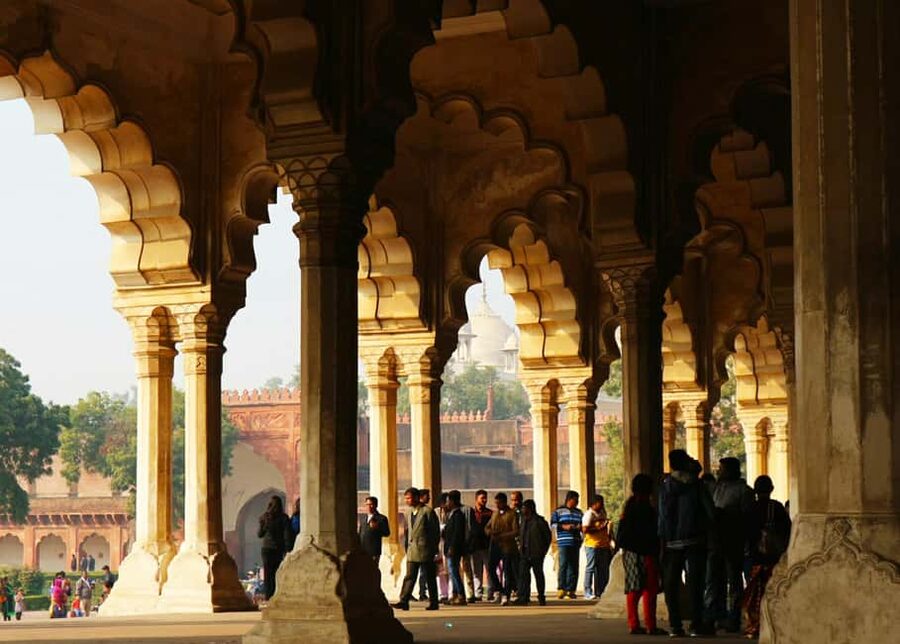
The first part of the visit helps you see why Agra Fort worked as a defensive site. Heavy walls, guarded gates, and controlled movement gave the complex a serious military purpose. Yet once inside, the architecture changes tone.
Look for Mughal arches, carved marble, and jharokhas, the projecting enclosed balconies used in Indian palace architecture. These features show the mix of Rajput, Persian, and Islamic styles that shaped the fort. The building is not one perfectly uniform design. Different rulers added, altered, or replaced parts of the complex.
This is where a live guide earns the $6 fee. A guide can point out details that blend into the larger walls, then explain how royal comfort sat beside military control. You move from thick defenses into polished courtly spaces without leaving the same fortified compound.
You should also expect uneven ground and plenty of walking. Comfortable shoes are not optional advice here. The fort is large, and the one-hour schedule works best if you keep moving between the main areas.
Diwan-i-Am: where the emperor met his subjects
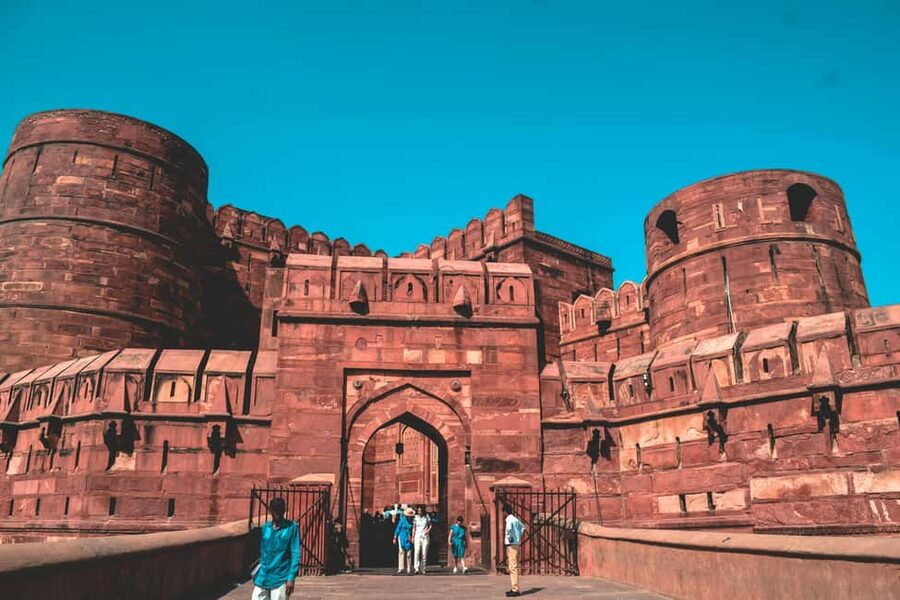
The Diwan-i-Am, or Hall of Public Audience, represents the emperor’s public role. This was a place for receiving subjects and handling petitions. Its pillared design gives it an open, formal feel, quite different from the more private palace rooms deeper inside.
A guide can help you imagine the hall as a working center of imperial government rather than a decorative ruin. Pay attention to the arrangement of columns and the broad space around the audience area. The layout helped make the emperor visible while keeping the court ordered and controlled.
This stop is especially useful if you are visiting Agra Fort after seeing the Taj Mahal. The Taj presents Shah Jahan as a patron of marble and symmetry. The Diwan-i-Am shows the political machine behind the monuments.
The visit also connects with the Peacock Throne, once associated with imperial ceremony. You can learn about the place where the legendary throne once dazzled the court, though the original throne is no longer there. That distinction matters: the fort gives you the setting and story, not the object itself.
More Walking Tours in Agra
- Agra Walking Tour
★ 5.0 · 109 reviews - Agra: Street Food Walking Tour, Spice Market, & Tuk-tuk Ride
★ 4.9 · 102 reviews - Agra 101 City Walk
★ 5.0 · 41 reviews - Flavours of Agra Food walk
★ 5.0 · 25 reviews
Diwan-i-Khas and Jahangiri Mahal
The Diwan-i-Khas, or Hall of Private Audience, takes you closer to the world of elite court business. This was not the broad public setting of the Diwan-i-Am. It was a more controlled space for important visitors and private discussions.
The shift between the two halls helps you understand the layers of Mughal power. One room displayed authority to a wider audience. The other protected access to the ruler. I find that contrast more useful than treating each hall as an isolated photo stop.
Jahangiri Mahal brings another change in mood. Its architecture combines sturdy massing with decorative details and shows how palace life could fit inside a fortress. The name links it with Emperor Jahangir, while the wider complex reflects additions and changes made across several reigns.
Look for the relationship between the courtyards, doorways, balconies, and shaded areas. A guide can explain how movement through the palace was managed, and why certain rooms feel formal while others feel more domestic. You may also notice the way red sandstone and marble are used together, creating a visual link between strength and luxury.
Musamman Burj and the view toward the Taj Mahal
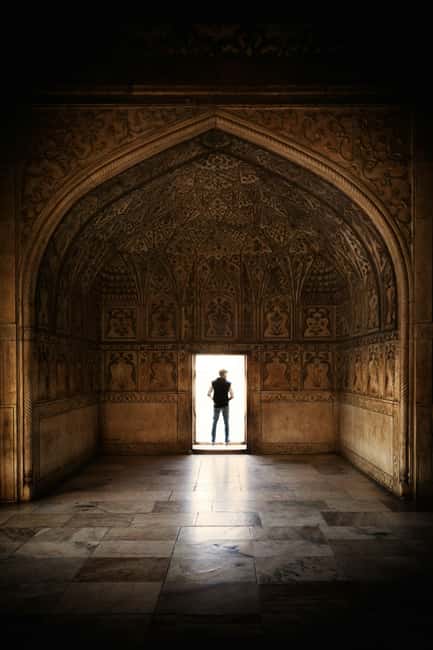
Musamman Burj is the emotional center of this tour. Shah Jahan was confined here by his son Aurangzeb and spent his final days looking toward the Taj Mahal. The story is memorable because it joins family conflict, imperial politics, and one of India’s best-known monuments in a single view.
The sight toward the Taj Mahal is also one of the best reasons to bring a camera. Your guide may know good places for photographs, and guides such as Shahid Khan have been praised for taking pictures at strong viewpoints. That can be useful if you are traveling alone or want everyone in your group included.
Keep your expectations realistic. The view is part of the fort experience, not a replacement for visiting the Taj Mahal itself. The two monuments show different sides of Mughal India. The Taj is a mausoleum built around memory and devotion. Agra Fort shows the ruler’s court, private life, military power, and eventual loss of control.
Because the Taj is only about 2.5 kilometers away, you can plan both visits on the same day. The fort tour works well earlier in your schedule if you want its history to give context to the Taj. You can also do the Taj first and then come here for the political and personal story behind Shah Jahan.
The mirrored palace and Anguri Bagh
If accessible during your visit, the mirrored palace adds a striking change from the fort’s red sandstone and open courtyards. Reflective surfaces create a very different mood, with light and decoration doing much of the work.
Access is not guaranteed, so treat this as a possible highlight rather than the main reason to book. A short guided visit can still be worthwhile if this room is closed, since the major halls, palace areas, and view from Musamman Burj remain central to the experience.
The Anguri Bagh offers another shift. Its geometric garden design brings order and greenery into the palace complex. The name refers to a grape garden, and the formal layout reflects the Mughal interest in carefully planned garden spaces.
This is a good place to slow down for a moment and take photographs. The garden also helps you picture royal leisure. After seeing audience halls and defensive walls, you get a glimpse of how queens and members of the court might have enjoyed a more private setting.
What the one-hour schedule really gives you
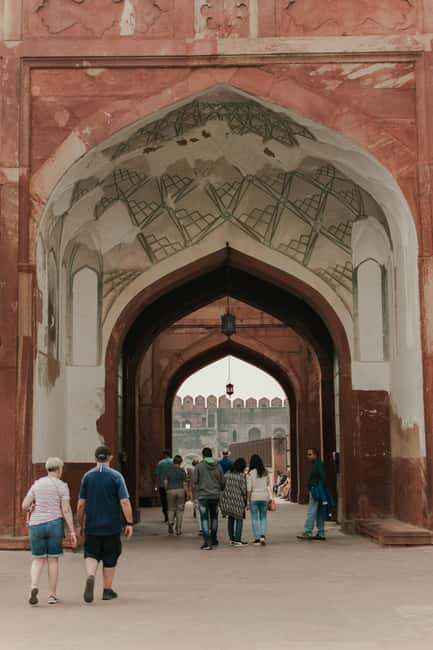
One hour is enough for a guided introduction to Agra Fort. It is not enough to inspect every courtyard, palace, inscription, and architectural detail. That is the central limit of this experience.
The short duration suits you if you have a packed Agra day, a train to catch, or a Taj Mahal visit planned nearby. It also works well if you prefer a clear route through the main sights instead of wandering through a vast complex without a plan.
The private format makes the hour more flexible. You can ask questions in English or Hindi, and the guide can adjust the pace within reason. If you arrive late, do not assume the visit can expand to make up the lost time. One guide was especially patient with a very late group, but that should be treated as kindness, not as part of the schedule.
A private group also means the experience can feel more personal than a standard crowd tour. Ask your guide to focus on the areas that matter most to you: Mughal politics, architecture, Shah Jahan, palace life, or photography. A good guide can make the same route feel different depending on your interests.
Guide quality and the value of local help
The strongest praise for this experience centers on the guides’ clear explanations, good timing, patience, and practical help. Gagan has been leading fort visits for 17 years and has been noted for arriving on time, communicating clearly, explaining the site, and taking photos. Shahid Khan has been praised for his enthusiasm, knowledge of the fort’s importance, photo help, and assistance during a weekend rush.
You may not receive either of these specific guides, so do not book on the assumption that one name is guaranteed. Still, their strengths show what to look for: someone who explains why a room matters, keeps the pace comfortable, points out good Taj Mahal views, and helps you avoid distractions at the entrance.
The guide can also help preserve your attention. Agra Fort has plenty to photograph, but without a clear story you may remember only red walls and marble decoration. A guide gives you a sequence: defense, government, royal residence, confinement, and garden life.
At $6, that personal explanation is the main value. You are not paying for transportation, a meal, or an all-day itinerary. You are paying for a focused human introduction to a complex site.
Who should book this Agra Fort tour?
I would choose this tour if you are visiting Agra for the Taj Mahal and want the fort to feel like part of the same story. It is also a good fit for first-time visitors who want the main rooms explained without spending half a day inside the complex.
It suits solo visitors who want help with photographs, couples who prefer a private pace, and families who may benefit from a guide keeping the route clear. English and Hindi are available, and the private format lets you ask questions as you go.
I would look elsewhere if you want a long, slow architectural study. One hour will feel tight if you want to read every inscription or linger in each palace. Since transfers are not included, this also is not an all-in-one Agra sightseeing package.
Wear comfortable shoes and bring a camera. Keep your belongings small enough for the security check, and plan the fort alongside the Taj Mahal rather than treating the two sights as separate parts of unrelated sightseeing.
Should you book it?
Yes, if you want a low-cost, focused way to understand Agra Fort. The guide adds the most value at the Diwan-i-Am, Diwan-i-Khas, Jahangiri Mahal, and Musamman Burj, where the building’s purpose and Shah Jahan’s story are easy to miss on your own.
Book it with the right expectations. You get one hour, not a complete fort study, and you arrange your own transport. For $6 per person, that is a fair trade. You receive a private guided route through one of Agra’s major sights, useful historical context, and a better chance of finding the best photo spots without losing time at the entrance.
FAQ
How long does the Agra Fort guided tour last?
The tour lasts one hour.
How much does the tour cost?
The listed price is $6 per person.
Is this a private tour?
Yes. The activity is offered for a private group.
Which languages does the guide speak?
Live guiding is available in English and Hindi.
Is transportation included?
No. Transfers are not included, so you must arrange your own way to Agra Fort.
Where do I meet the guide?
You enter through Amar Singh Gate, the sole visitor entrance. The local service provider sends the guide’s contact details by WhatsApp, or by email if you do not use WhatsApp, one day before the tour.
Which parts of Agra Fort are included?
The route highlights the Diwan-i-Am, Diwan-i-Khas, Jahangiri Mahal, Musamman Burj, the mirrored palace if accessible, and Anguri Bagh.
Can I take photographs?
Yes. Photography is allowed, but drones and tripods are usually prohibited without special permission.
What should I bring?
Bring comfortable shoes and a camera. The fort has uneven surfaces and requires plenty of walking.
Can I visit the Taj Mahal on the same day?
Yes. The Taj Mahal is about 2.5 kilometers from Agra Fort, making it practical to plan both visits on the same day.
More Agra Fort Visits
- Agra: Skip-the-Line Taj Mahal & Agra Fort Private Tour
★ 4.9 · 1,546 reviews - Taj Mahal, Agra Fort, Baby Taj & Mehtab Bagh Private City Tour
★ 5.0 · 391 reviews - Skip-the-Line Guided Taj Mahal & Agra Fort Tour with Add-ons
★ 5.0 · 339 reviews - Same Day Taj Mahal, Agra Fort & Baby Taj Tour from Jaipur by Car
★ 5.0 · 242 reviews
Recently added around Agra
- Taj Mahal Entrance Ticket★ 5.0 · 3 reviews
- Agra’s Hidden Gems & Flavors on a Thrilling Tuk-Tuk Tour 3-4 Hrs★ 5.0 · 3 reviews
- Spiritual Private Tour of Vrindavan and Mathura★ 3.0 · 3 reviews
- Agra: Taj Mahal and Agra Fort Private Guided Half-Day Trip★ 5.0 · 3 reviews
- Shop Agra Like a Local: Unique Indian Handicrafts Tour★ 5.0 · 3 reviews
- From Jaipur: Taj Mahal Guided and Agra Tour By Car★ 5.0 · 3 reviews
- Private Transfers Jaipur To Agra Drop with sikri & stepwell★ 5.0 · 3 reviews
- Full day Taj Mahal, Agra Fort, Fatehpur Sikri By Car From Agra★ 5.0 · 3 reviews
Agra Fort Tours, compared.
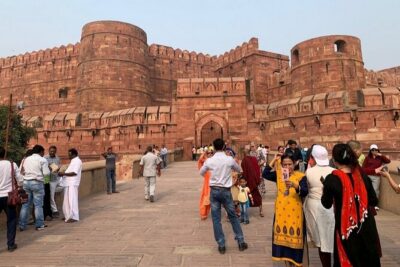
Skip-the-Line Taj Mahal & Agra Fort Private Tour
Read our review →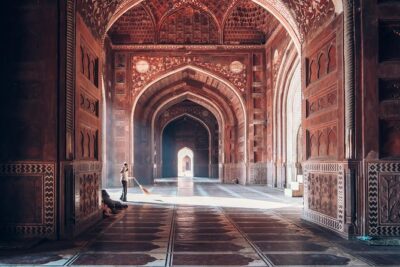
Taj Mahal, Agra Fort, Baby Taj & Mehtab Bagh Private City Tour
Read our review →
Skip-the-Line Guided Taj Mahal & Agra Fort Tour with Add-ons
Read our review →
Same Day Taj Mahal, Agra Fort & Baby Taj Tour from Jaipur by Car
Read our review →
Skip the line with Private Tour Guide for Taj Mahal & Agra Fort
Read our review →
Premier Tour of Taj Mahal & Agra Fort All Inclusive
Read our review →
Private Taj Mahal Sunrise and Agra Fort Skip the Line Tour
Read our review →
Same Day Taj Mahal, Agra Fort & Baby Taj Tour from Jaipur
Read our review →Browse the lists this tour appears in